From Swedish pop revolution to global cultural heritage
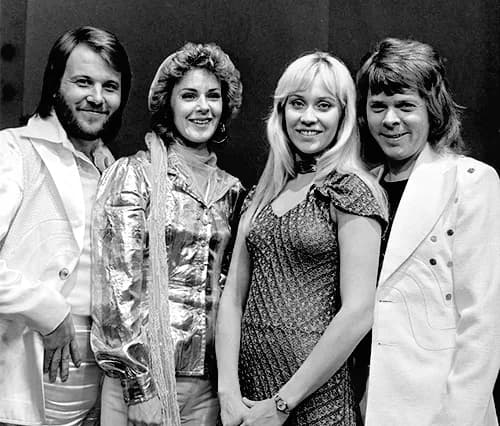
Photo: AVRO, CC BY-SA 3.0 nl via Wikimedia Commons
ABBA is Sweden's most successful pop group – and one of the best-selling music acts in the world. Formed in Stockholm in 1972 by Agnetha Fältskog, Björn Ulvaeus, Benny Andersson and Anni-Frid Lyngstad.
The 1974 Eurovision win with Waterloo put Swedish pop on the world map. Dancing Queen, Mamma Mia and Fernando followed. Over 400 million records sold worldwide.
The group took a break in 1982, but the music lived on through the musical Mamma Mia! (1999) and two film adaptations.
In 2021 came the album Voyage – and a hologram show in London where digital 'ABBAtars' perform with a live band. Over 4 million visitors so far.
ABBA is one of the world's most successful pop groups and one of Sweden's most significant cultural phenomena. The group was formed in Stockholm in 1972 by Agnetha Fältskog, Björn Ulvaeus, Benny Andersson and Anni-Frid 'Frida' Lyngstad. Their breakthrough came in 1974 when they won the Eurovision Song Contest with Waterloo — a moment that not only transformed their career but put Swedish pop music on the world map. Throughout the rest of the 1970s, ABBA dominated international charts with hits like Dancing Queen, Mamma Mia and Fernando. Their music is characterised by melodic perfection, sophisticated studio production and a unique blend of joy, drama and Nordic pop sensibility. The group sold over 400 million records globally and remains one of the most successful music acts in history.
ABBA originally consisted of two couples, and their personal relationships influenced both the group's dynamic and the emotional tone of the music. Towards the end of the 1970s the relationships began to fracture, and in 1982 the group ended its active period. Despite this, the music lived on through compilation albums, musicals and film adaptations. Mamma Mia! (1999) became a global sensation and was followed by two films (2008 and 2018) that introduced ABBA to new generations.
Although ABBA never officially disbanded, it took nearly 40 years before they returned with new music. In 2021 the album Voyage was released, together with a groundbreaking hologram show in London where digital 'ABBAtars' perform with a live band — a project that has become an international audience magnet. ABBA also continues to be culturally relevant through musicals, anniversaries and ever-growing fan bases. In 2026, the 50th anniversary of Fernando was celebrated, and ABBA Voyage recently passed 4 million visitors.
ABBA was formed in Stockholm in 1972 by Agnetha Fältskog, Björn Ulvaeus, Benny Andersson and Anni-Frid Lyngstad.
ABBA won the Eurovision Song Contest in 1974 with the song Waterloo — a breakthrough that put Swedish pop music on the world map.
ABBA has sold over 400 million records globally and is considered one of the most successful music acts in history.
ABBA Voyage is a hologram show in London where digital 'ABBAtars' perform with a live band. The show opened in 2022 and has surpassed 4 million visitors.
ABBA never officially disbanded. The group returned in 2021 with the album Voyage after nearly 40 years of silence, and the hologram show in London continues to run.
